
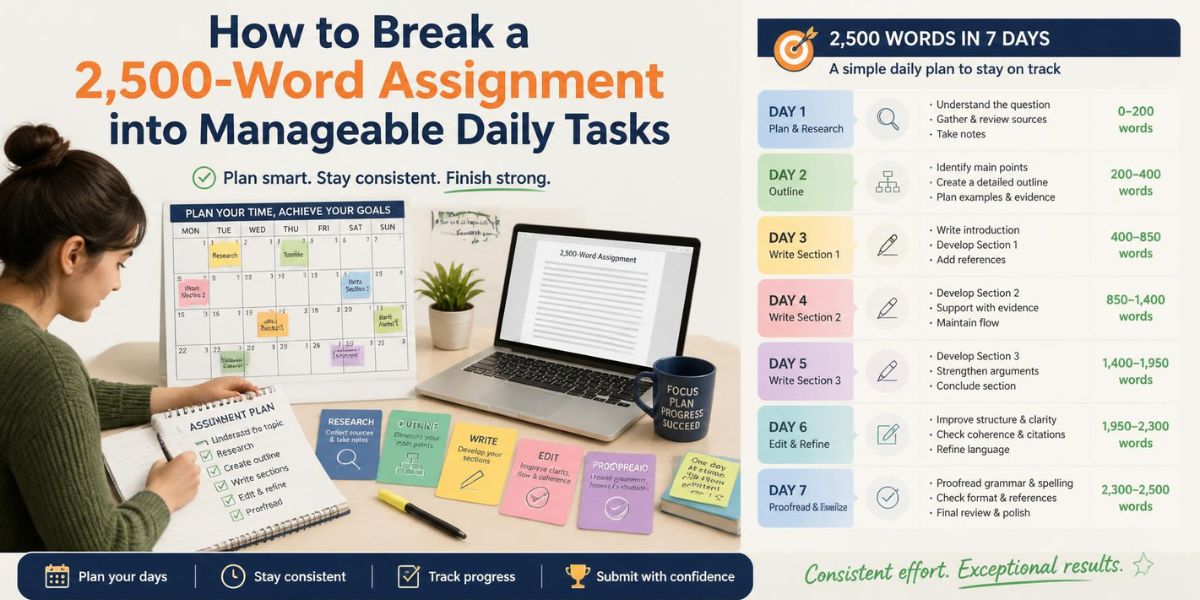
How to Break a 2,500-Word Assignment into Manageable Daily Tasks
Breaking a huge assignment into your routine requires setting a timeline and a logical structure for your assignment. A 2500-word assignment is a huge nightmare for a lot of students. Completing all of it in a single day is nearly impossible, as you will get exhausted instead of learning something new.
So what is the right way to begin? How can you actually distribute that assignment into manageable tasks while giving yourself time to enjoy other activities? This is where you need to unlock the secret that many students already have. Continue reading to learn how you can distribute your academic responsibilities into daily tasks.
How To Meet The Deadline Of Your 2500 Word Assignment?
You need to start by thinking, “What can I realistically complete today?” at first.
This small shift will remove much of the pressure, and then here is what you need to do next.
Day One- Understand the Assignment Before You Write
A lot of students lose valuable time and run to take MBA assignment help because they begin writing before fully understanding what the assignment actually requires.
This is why you should always spend your first session answering questions such as:
- What is the assignment asking me to discuss?
- What type of evidence will I need?
- Are there specific formatting or referencing requirements?
- What is the marking criteria?
You should then move ahead to collect your research materials and begin organizing useful sources once you understand the expectations.
Make sure to resist the temptation to start writing immediately, as good preparation usually saves far more time later.
Day Two- Build a Detailed Outline
A detailed outline removes much of the uncertainty from the writing process, so instead of trying to write 2,500 words in one sitting, you should be filling in sections you’ve already planned.
Your outline might include:
- Introduction
- Main Point One
- Main Point Two
- Main Point Three
- Counterargument or discussion
- Conclusion
Write several bullet points explaining what you plan to include under each heading. Remember, you don’t need to worry about writing polished sentences at this stage, as your goal is to create a clear roadmap right now.
Day Three- Write the First Half
You will notice the writing process becoming less intimidating once you have completed your outline. Just don’t try to follow the pattern of perfection, as your goal should be gathering information at this point.
Complete the introduction and the first major sections while your research is still fresh in your mind.
Editing will work much better after the ideas are already on the page than during the first draft.
A lot of students discover they write faster than expected once they stop trying to make every paragraph perfect the first time.
Day Four – Finish the Remaining Sections
By this point, you’ve already completed the most difficult part, which is getting started.
Now your attention shifts to finishing the remaining body paragraphs and writing the conclusion.
You should concentrate on answering the assignment question thoroughly instead of constantly checking the word count. Strong arguments supported by relevant evidence will naturally increase the length of the paper without repetition.
If one section feels weak, make a note and continue with the next part. You can always return during editing.
Progress is more valuable than perfection during the drafting stage.
Day Five- Step Away Before Editing
A lot of students begin editing immediately after finishing their draft, and this approach usually makes mistakes harder to spot because the writing is still familiar.
This is why you should always leave the assignment for several hours or even overnight before reviewing it.
Make sure to read it properly when you return with your fresh eyes.
Ask yourself:
- Does every paragraph answer the assignment question?
- Are the transitions between ideas clear?
- Have I repeated the same point in different words?
- Does every source support the argument effectively?
This approach will help you identify improvements that were invisible during writing.
Leave Proofreading Until the End
Proofreading should always be the final stage because there’s little benefit in correcting punctuation if entire paragraphs may still change.
During your final review, pay attention to:
- There are no spelling and grammatical errors.
- Every citation is complete and accurate.
- The formatting requirements are fulfilled.
- You have mentioned all the page numbers and headings.
You can also choose to read the assignment aloud to identify sentences that feel complicated in your academic work. But if it still feels difficult, you can contact an assignment helpline offering these services.
Small Daily Goals Work Better Than Marathon Sessions
One common belief is that you need a lot of uninterrupted hours before making progress. This is where things mess up. The truth is that shorter and focused study sessions produce better results.
You should write for 45 to 60 minutes each day, which is a more productive approach than attempting to complete the entire assignment in one exhausting evening.
These short sessions help maintain concentration and reduce the mental fatigue that often leads to careless mistakes.
Helpful Habits That Save Time
Small routines often make a bigger difference than complicated productivity systems.
For example:
- Keep all research articles organized in one folder before writing begins so you don’t end up searching for sources.
- Save your document regularly and back it up using cloud storage to avoid losing work.
- Write first and edit later, as separating those tasks allows ideas to flow more naturally.
- Set realistic daily targets based on time for better productivity levels.
These habits will become even more valuable when you get more tasks assigned.
FAQS
-
How many words should I write every day for a 2,500-word assignment?
The answer depends on the number of days you are left with. 500 words per day is a better choice if you are left with five writing days. Just don’t forget to be consistent.
-
Should I finish all my research before I start writing?
You can, but there is also a chance of finding more sources during the drafting stage. Just avoid interrupting your writing every few minutes to search for new information.
-
What if I can’t reach my daily writing goal?
Don’t panic. Review your schedule and focus on completing the most important sections first. Your focus should be on working through a flexible plan instead of getting disappointed because one didn’t go as planned.
Wrapping Up
A 2,500-word assignment feels overwhelming for many students, but only when they view it as a huge task. Your workload will become much easier if you divide it into smaller daily objectives instead of trying to complete everything at the last moment. So make sure to follow the timeline mentioned above and keep yourself free from the stress of incomplete assignments.

I specialize in academic content writing that is clear, well-structured, and research-driven. From essays and research-based articles to reports and educational material, I focus on accuracy, clarity, and adherence to academic standards. I have a strong understanding of academic formatting and guidelines.